

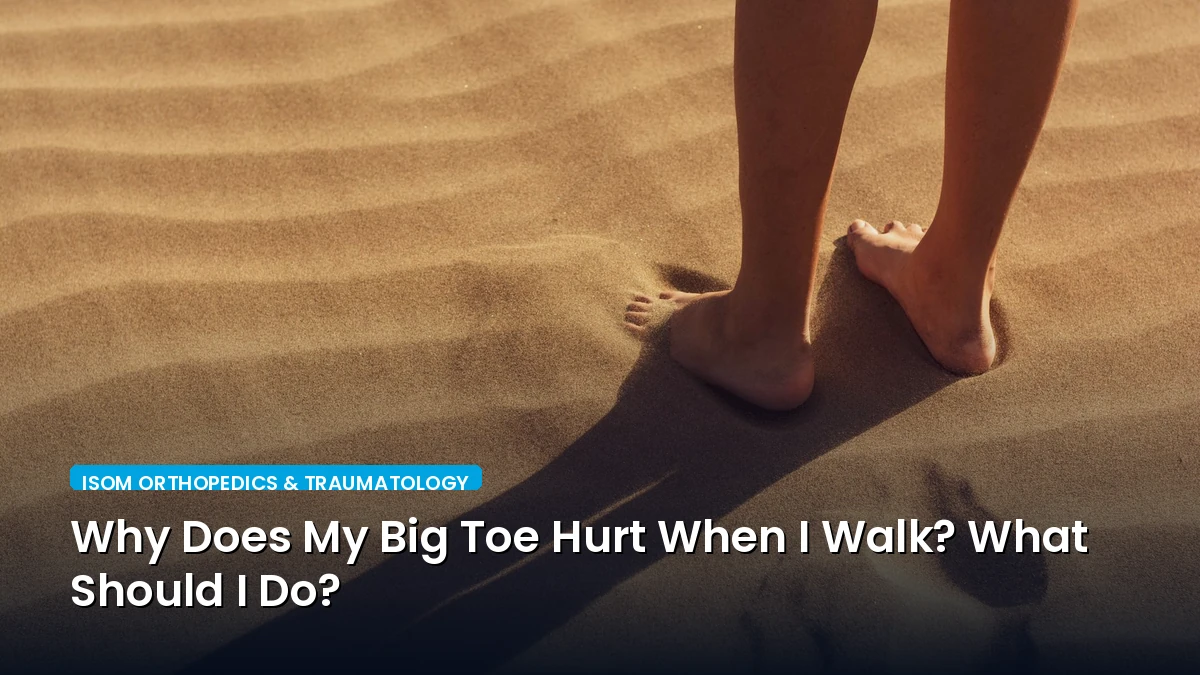
Big toe pain while walking may be related to tight shoes, a change in the big toe joint, repeated overload, tendon irritation, or an injury. Rest and roomy footwear may help at first. Swelling, redness, warmth, fever, or inability to bear weight should prompt an orthopedic assessment.
Key Points
- Possible cause: Shoe pressure, hallux valgus, joint overload, or injury can cause big toe pain.
- First step at home: Reduce loading, rest the foot, and choose a wide toe box with a stable sole.
- Avoid: Painful walking, tight shoes, and forceful big toe exercises until the cause is clearer.
- When to seek care: Get prompt assessment for severe pain, marked swelling, redness, warmth, fever, or inability to bear weight.
Big toe pain while walking can turn an ordinary daily activity into a persistent problem. It may start mildly and become clearer as the number of steps increases. Some people shift weight toward the outer border of the foot, which can later affect comfort around the sole, ankle, or knee. The location of pain, its timing, footwear triggers, and any visible change around the big toe all matter.
This article focuses on the big toe and its immediate joint. Advice for the wrist, ankle, or knee should not be transferred automatically to this area. The cause cannot be confirmed without an examination, but the following guide explains which features to observe and when to arrange care.
Why does my big toe hurt when I walk?
Common causes include repeated loading during the final part of a step, pressure from footwear, and irritation around the joint. A big toe that angles toward the second toe with a prominence at the inner side may fit hallux valgus. Other possibilities include limited joint motion, tendon irritation, a corn, a minor impact, or a sports-related soft tissue injury.
The quality of pain provides useful context. Burning or rubbing pain inside a shoe suggests mechanical pressure. Stiffness or catching during push-off may reflect restricted joint motion. Sudden severe tenderness with swelling requires a different assessment. Numbness may occur when footwear compresses nearby tissues, but persistent or spreading sensory change should be examined.
Can hallux valgus cause big toe pain?
Yes. Hallux valgus can make the big toe painful during walking, although the amount of visible change does not always match symptom intensity. As the toe angles outward, the base of the first metatarsal becomes more prominent on the inner side. Shoe pressure can then produce redness, rubbing, and tenderness. A person may reduce push-off through the big toe and change the way they walk.
Assessment considers more than the size of the prominence. Joint motion, the relationship with the second toe, pressure under the forefoot, and footwear are also relevant. If the shape is changing, pain keeps returning, or walking mechanics are affected, an orthopedic examination is appropriate. Pads or spacers may reduce pressure for some people, but they should not be viewed as a way to permanently realign bone.
Which big toe symptoms matter?
Duration, exact location, and associated findings help guide assessment. Tenderness along the joint line, redness where the shoe rubs, reduced motion, and swelling after a long walk are common patterns. Pain around the nail or skin may have a local cause. Pain beneath the big toe can relate to pressure distribution or soft tissues rather than the joint itself.
Prompt attention is important after a fall or impact with deformity or inability to bear weight. Rapid swelling, marked redness and warmth, fever, an open wound, unexplained bruising, or new significant numbness should not be ignored. People with diabetes, immune conditions, or previous foot surgery may need a lower threshold for assessment.
What can I do at home for big toe pain?
Temporarily reduce walking, running, jumping, and prolonged standing if they increase symptoms. Do not force the big toe backward while resting. If swelling is present, elevation may be comfortable. A cold pack wrapped in cloth can be used for short intervals, but ice should not touch the skin directly. People with reduced sensation or circulation concerns should ask a health professional before using cold.
Footwear is important. Choose a roomy toe box, soft upper, stable sole, and a fit that does not squeeze the toe from above or the side. Avoid cutting a corn yourself, forcibly straightening the toe, deep massage over a very tender joint, or continuing the same training through sharp pain. Medication decisions depend on medical history and current medicines; a dose should not be selected without personal advice.
How is big toe pain diagnosed?
An examination reviews the exact pain site, joint motion, toe alignment, pressure points, and weight transfer during walking. The clinician may ask when symptoms began, whether footwear or activity changed, and whether there was an injury. Looking at the foot both sitting and standing can show how alignment changes under load.
When needed, a weight-bearing X-ray can show bone alignment and joint space. Other imaging may be selected when a tendon, ligament, or soft tissue problem is suspected. A red, hot, swollen joint may need assessment for inflammatory or infectious causes. Imaging is interpreted together with symptoms and examination, not as an isolated treatment decision.
| Pattern | Possible explanation | Initial approach | When assessment is needed |
|---|---|---|---|
| Pressure and redness along the inner big toe in shoes | Mechanical rubbing or hallux valgus | Roomy footwear and reduced loading | Recurring pain or progressive change |
| Stiffness at push-off | Restricted motion or overload | Temporarily reduce aggravating activity | Persistent pain or clear motion loss |
| Swelling and inability to bear weight after impact | Fracture, crack, or soft tissue injury | Protect the foot and avoid loading | Same-day evaluation |
| Rapid redness, warmth, and marked tenderness | Inflammatory or infectious joint problem | Do not stress the area | Prompt medical assessment |
How are treatment and return to activity planned?
Treatment depends on the cause and the condition of the big toe joint. Mechanical pressure may be addressed through footwear and load changes. Limited motion may lead to controlled exercise or physiotherapy. An injury may require protection, a period of reduced weight bearing, and follow-up. With hallux valgus, early care often focuses on reducing the pressure that provokes symptoms. Persistent symptoms require an orthopedic discussion of further options.
Return to running, jumping, or long walks should be gradual rather than based on a single pain-free hour. Start with a short, flat walk in suitable footwear. If pain and swelling do not increase later that day or the next morning, duration can be increased slowly. Sharp pain, limping, or prolonged post-activity swelling means the level should be reduced. A tailored physiotherapy plan can address weight transfer and control around the foot. Information about rehabilitation services may help explain this approach.
For movement assessment, the physiotherapy service can be reviewed alongside the glossary information on big toe injuries. These pages do not replace a personal diagnosis; recurring big toe pain should be assessed in context.
When should I see a doctor for big toe pain?
Arrange an orthopedic appointment if pain is worsening, changes your walking, or continues despite appropriate footwear and reduced loading. A recent injury with deformity, inability to bear weight, rapidly increasing swelling, bruising, an open wound, fever, or a hot red joint may require urgent assessment. Recurrent symptoms or a growing prominence should also be reviewed before they limit footwear and activity further.
Before the appointment, note when pain began, which shoes trigger it, how it affects walking, and what supports or activity changes you tried. Observing when swelling or redness appears can help the clinician understand how the big toe behaves under load.
Frequently asked questions about big toe pain
Can big toe pain go away on its own?
It may settle when temporary shoe pressure or mild overload is removed. Repeated pain, visible alignment change, or reduced motion deserves assessment.
How can hallux valgus pain be reduced?
A roomy toe box, less pressure, and an individualized follow-up plan may help. Progressive deformity or walking limitation requires examination.
Can I walk while my big toe hurts?
If there is no sharp pain, limp, or swelling, a short flat walk may be reasonable if it does not worsen symptoms. Stop if pain increases.
Should I exercise the big toe while it hurts?
Exercise should not increase pain. After injury, marked swelling, or suspected joint inflammation, seek assessment before starting exercises.
Which specialist should I see for big toe pain?
Orthopedics and traumatology can assess the big toe joint, bones, ligaments, and soft tissues. Physiotherapy may be added when appropriate.
Consult Our Orthopedic Specialists
Contact our medical team in Istanbul for questions about your diagnosis, surgical options, and appointment scheduling.