



Elbow clicking is often related to joint movement, a tendon shifting over nearby tissue, or a previous overload. If the sound is painless and there is no swelling, locking, weakness, or loss of motion, it is usually not an emergency. Pain, injury, or restricted movement should be assessed by a clinician.
Key Points
- Why: Joint motion, tendon friction, loading, or a previous impact can create a clicking sound.
- At home: Reduce painful loading, move the elbow through a comfortable range, and return to daily tasks gradually.
- Avoid: Do not force the elbow to reproduce the sound or continue painful lifting and pressing.
- When to seek care: Arrange an assessment for swelling, marked pain, locking, numbness, weakness, or a sound after injury.
Why does my elbow click?
An elbow click does not always mean that something is damaged. When the elbow bends and straightens, the joint surfaces, ligaments, tendons, and nearby tissues move together. A tendon may shift over a bony area, or normal joint motion may create a sound. A painless click without swelling or loss of movement is often less concerning, but a new painful sound needs attention.
Note when the sound began, whether it appears with one specific movement, and whether it is felt at the inner, outer, or back part of the elbow. Repeated gripping, lifting, throwing, keyboard work, or leaning on the elbow can increase local load. A fall, blow, or previous dislocation may also change how the joint moves. The sound alone cannot establish a diagnosis; associated symptoms guide the next step.
Is a painless elbow click normal?
A painless sound with full movement, normal strength, and no swelling can often be observed. The key issue is function: if you can bend and straighten the elbow and complete daily tasks comfortably, an urgent visit is usually not required.
Observation does not mean ignoring every change. A new click after an injury, a catching sensation, tenderness, weakness, or progressive stiffness should be assessed. Pain that wakes you at night, increasing swelling, warmth, or fever requires a more timely review. A short symptom diary can record the activity, position, pain, swelling, and recovery after rest.
Which symptoms suggest an elbow problem?
Pain, swelling, reduced movement, catching, or an inability to fully straighten the elbow make a click more clinically relevant. Tingling toward the little-finger side may indicate nerve irritation, while loss of grip during lifting can involve a tendon, joint, or nerve.
Different patterns need different examinations. Swelling at the back of the elbow, tenderness after repeated loading, or numbness when the elbow stays bent should be described clearly. After a fall, deformity, rapid swelling, or inability to move the arm is a reason not to force the joint. Even if pain settles, persistent clicking with restricted movement should be reviewed.
What can I do at home for an elbow click?
Stop repeatedly testing the movement that produces the sound. Temporarily reduce painful lifting, pressing, prolonged support, and repetitive gripping. Do not immobilize the elbow completely unless advised; slow movement within a comfortable range helps preserve mobility.
At work, avoid resting the elbow on a hard edge and keep the forearm supported without prolonged pressure. In sport, do not increase load, speed, and repetitions at the same time. A wrapped cold or warm application may be comfortable for a short period, but never place it directly on the skin and stop if numbness occurs. Medication choices depend on medical history and other medicines, so an examination is needed before individualized advice.
How is an elbow click examined?
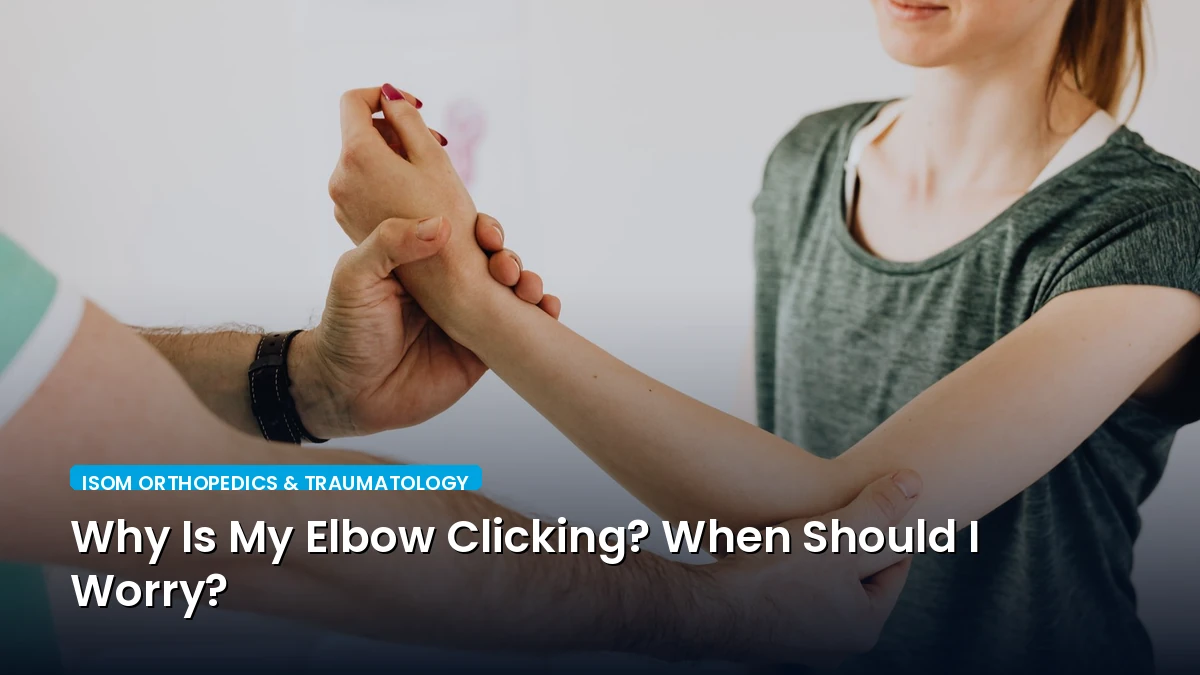
A clinician checks which angle produces the sound, whether it is painful, the range of motion, strength, sensation, and circulation. Different movements help distinguish a sound from inside the joint from a tendon moving over nearby tissue.
An X-ray, ultrasound, or magnetic resonance scan may be selected when the examination indicates a need; every patient does not require the same test. Age, work, sport, injury history, and symptom pattern are considered together. A scan finding is not automatically the source of pain, so results must be interpreted with the examination and the person’s functional limitations.
When can I return to sport?
If movement is full, strength is normal, and there is no pain or swelling, a gradual return to ordinary activity is reasonable. When symptoms exist, return should be based on the elbow tolerating load rather than on the sound disappearing completely.
Start with low resistance and shorter sessions. If there is no meaningful increase in pain or swelling the next day, progress one factor at a time. Throwing, racket, weight training, and support exercises should be reviewed for technique, grip, volume, and rest periods. Do not use pain relief to hide symptoms while rapidly increasing the training load.
How should activity be adjusted?
The aim is to protect the elbow without keeping it completely still. Continue comfortable tasks, break painful tasks into shorter intervals, and increase load in small steps. The ISOM pages on orthopedics and traumatology, traumatology assessment, and physiotherapy explain assessment, injury review, and movement-based care. These resources are general information and do not replace an individual examination.
| Finding | Possible meaning | Initial approach |
|---|---|---|
| Painless sound | Tendon or joint movement | Observe, move comfortably, adjust load gradually |
| Sound with loading pain | Tendon or joint irritation | Reduce painful load and arrange assessment |
| Sound after injury | Possible bone, ligament, or joint involvement | Avoid force and seek timely review |
| Sound with numbness or weakness | Possible nerve or joint problem | Arrange an early clinical assessment |
When should an elbow click be taken seriously?
Do not wait when a new click comes with pain, swelling, redness, warmth, locking, numbness, weakness, or deformity. After an injury, inability to use the elbow, rapidly increasing swelling, or changes in finger colour or sensation need prompt assessment. Even mild symptoms deserve a planned appointment if they do not improve over several days or become more frequent. Tell the clinician which movement produces the sound and which tasks increase it.
Can an elbow click go away on its own?
Painless clicks may become less noticeable when the provoking load is reduced. A persistent sound without other symptoms can be discussed at a planned appointment.
Does an elbow click mean arthritis?
A sound alone does not diagnose arthritis. Pain, stiffness, reduced movement, or previous injury determine whether an examination and imaging are useful.
Which clinician should assess an elbow click?
Orthopedics and traumatology can assess injury and joint-related symptoms. Physiotherapy may be included when the pattern relates to loading and movement control.
Can I exercise when my elbow clicks?
Gentle controlled movement may be reasonable if it is painless. Stop loaded exercise when clicking comes with pain, swelling, weakness, or loss of motion.
Is a painless elbow click an emergency?
Without pain, swelling, deformity, locking, numbness, or weakness, it is usually not urgent. A new persistent change still deserves a planned review.
Consult Our Orthopedic Specialists
Contact our medical team in Istanbul for questions about your diagnosis, surgical options, and appointment scheduling.