

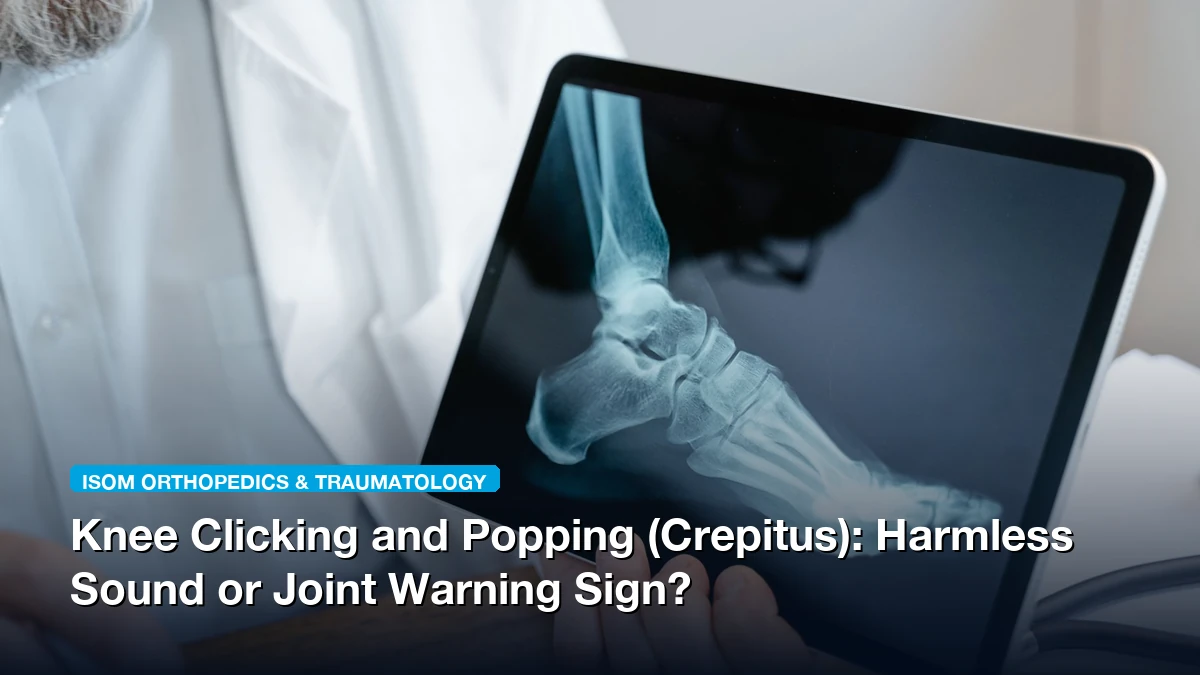
Knee clicking, snapping, or grinding (clinically known as crepitus) is harmless in the vast majority of cases when experienced without accompanying pain or swelling. It typically stems from benign gas cavitation inside the synovial fluid or tendons momentarily snapping over bony prominences. However, if joint sounds are paired with sharp pain, swelling, mechanical locking, or a persistent sand-paper grinding sensation, it signifies structural cartilage erosion or a torn meniscus flap that demands timely orthopedic evaluation.
Key Takeaways & Assessment Criteria:
- The Golden Rule: Noise alone is simply anatomy in motion. Noise accompanied by discomfort, swelling, or catching is joint pathology.
- Gas Cavitation: A single, distinct 'pop' when bending is harmless nitrogen bubble collapse within synovial fluid.
- Grinding Sensations: Continuous crunching during squats suggests patellofemoral cartilage softening (chondromalacia).
- Second Opinions in Istanbul: International patients facing long waitlists for diagnostic MRI scans in Europe can access same-week advanced imaging, biological joint injections, and specialized arthroscopy at ISOM.
Every time you bend down to tie your shoes or stand up from a chair, your knee releases an audible snap or a sandpaper-like crunch. Many patients wonder in alarm: "Is my knee deteriorating? Am I getting early arthritis?"
At Istanbul Surgical and Orthopedic Center (ISOM), we evaluate international patients from across the world who are understandably anxious about joint noises. The good news is that knee noises (crepitus) are extraordinarily common, and most do not indicate permanent damage. In this comprehensive medical guide, we explain the mechanics of joint sounds, how to distinguish benign pops from cartilage distress, and when to seek specialized care.
What Causes the Knee to Make Noise?
The knee joint contains bones, cartilage, ligaments, tendons, and a lubricating fluid called synovial fluid. Clicking and popping originate from three distinct physical sources:
- Cavitation (Gas Bubbles): Changes in intra-articular pressure cause microscopic nitrogen bubbles to form and rapidly implode within the synovial fluid. This is identical to cracking your knuckles and causes zero joint damage.
- Tendon Snapping: As the knee bends, tendons adjust their alignment over bone contours. If muscles are tight, a tendon may flick across a bony ridge like a guitar string, creating a distinct snap.
- Articular Cartilage Friction: When healthy cartilage loses its glassy smoothness, the rough surfaces rub against one another under weight-bearing loads, creating fine, audible grating.
Self-Assessment: Benign Clicking vs. Warning Crepitus
| Indicator | Harmless Physiological Sound | Pathological Warning Sign |
|---|---|---|
| Pain | None whatsoever | Sharp pinch, ache, or warmth |
| Joint Swelling | Joint contours remain normal | Puffiness, effusion, or heat |
| Mechanical Catching | Smooth, full range of motion | Knee locks or gives way unexpectedly |
Protecting Your Knee Cartilage: 3 Safe Exercises
- Stationary Cycling with Low Resistance: Pedaling gently circulates synovial fluid, delivering oxygen and nutrients to the articular cartilage without compressive ground impact.
- Straight Leg Raises: Strengthens the quadriceps muscle chain in a static position, providing muscular stability to the kneecap without joint friction.
- Glute Bridges: Weak hip abductors cause the knee to collapse inward during squats, triggering tracking friction. Strengthening the glutes realigns the leg axis.
The Benefit of Rapid Orthopedic Evaluation in Istanbul
If your knee crepitus is accompanied by pain, waiting months for an MRI scan under strained national healthcare systems can allow a minor cartilage fissure to progress into advanced osteoarthritis. Early intervention preserves natural joint tissue and prevents major joint replacement surgeries down the line.
ISOM Orthopedics in Istanbul provides comprehensive international concierge care:
- Same-Week Access: Dedicated consultation with leading orthopedic knee specialists.
- Advanced 3T MRI & Dynamic Imaging: Instant visualization of cartilage fissures, meniscal root tears, and patellofemoral tracking dynamics.
- Regenerative Medicine: State-of-the-art Platelet-Rich Plasma (PRP) and hyaluronic acid viscosupplementation to restore joint lubrication.
- Minimally Invasive Arthroscopic Solutions: Keyhole smoothing and meniscal preservation techniques when conservative therapy is insufficient.
Frequently Asked Questions
Why does my knee pop when I squat?
Squatting places peak compressive forces on the patellofemoral joint. If you feel no pain, it is simply gas bubble release or the quadriceps tendon gliding over bone. If pain accompanies the pop, have your kneecap tracking examined.
Can knee crepitus be completely cured?
Benign clicking needs no cure—it is normal physiological function. For pain-associated crepitus, strengthening surrounding muscles and restoring joint lubrication through targeted therapies effectively silences painful friction.
Clarity and Relief for Your Knees
Determine whether your knee sounds are harmless or require proactive cartilage protection. Reach out to ISOM's orthopedic team in Istanbul via WhatsApp today.
💬 Connect on WhatsApp with ISOM SpecialistsConsult Our Orthopedic Specialists
Contact our medical team in Istanbul for questions about your diagnosis, surgical options, and appointment scheduling.