

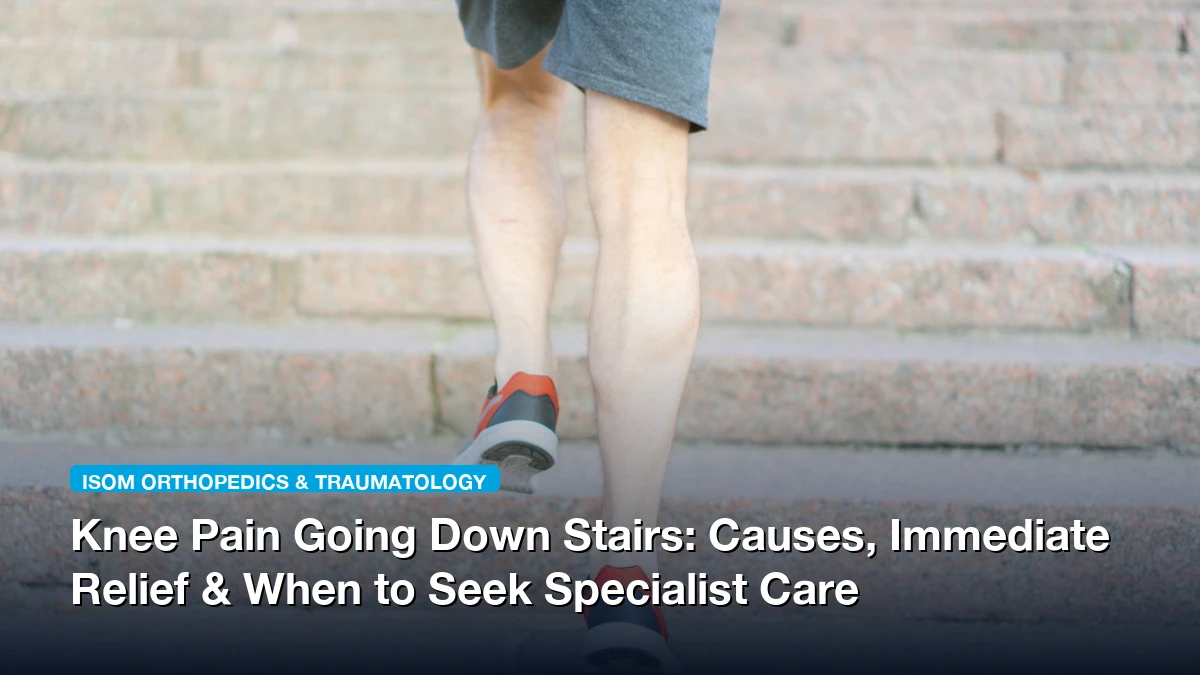
Knee pain that spikes specifically when descending stairs is most commonly triggered by Patellofemoral Pain Syndrome (runner's knee) or chondromalacia patellae. Walking down stairs forces the quadriceps muscle into an eccentric contraction that multiplies compressive pressure on the kneecap cartilage by 3.5 to 4 times body weight. Initial conservative management includes ice application, avoidance of deep squats, and targeted VMO strengthening. If accompanied by joint locking or instability, prompt orthopedic evaluation is vital to prevent irreversible cartilage wear.
Key Takeaways & Patient Guidance:
- Why Going Down Is Harder: Ascending requires concentric muscle drive, but descending requires eccentric braking against gravity, concentrating tremendous force under the patella.
- Home Relief: Ice for 15 minutes after stair descent and lead with the unaffected leg when walking down.
- The Cost of Waiting: In many national healthcare systems (such as the UK's NHS), waiting months for an MRI or specialist consultation can allow early cartilage irritation to progress into chronic osteoarthritis.
- Fast-Track Care in Istanbul: ISOM provides international patients with immediate same-week advanced 3T MRI, dynamic joint alignment evaluation, and joint-preserving biological treatments.
You can walk on flat pavement for miles without a problem, but the moment you take your first step down a flight of stairs, a sharp, aching catch pierces through the front of your knee. Many patients ask: "Why can I walk upstairs with minimal discomfort, but going downstairs feels unbearable?"
This common orthopedic presentation is rooted in the biomechanics of joint deceleration. At Istanbul Surgical and Orthopedic Center (ISOM), we see hundreds of international patients who have struggled with undiagnosed or prolonged stair-descent knee pain. This comprehensive guide outlines the root causes, daily ergonomic modifications, home rehab steps, and clinical options when conservative measures are not enough.
The Biomechanics: Why Descending Stairs Strains the Knee
When you walk downstairs, your knee acts as a hydraulic shock absorber. Your quadriceps muscles must lengthen under load to gently lower your body weight to the next step—a process known as eccentric contraction.
- 400% Body Weight Load: While normal level walking exerts approximately 0.5 times your body weight on the patellofemoral joint, descending stairs exerts up to 3.5 to 4 times your body weight directly behind the kneecap.
- Cartilage Friction: If the cartilage lining the underside of the patella is irritated, soft, or worn thin, this intense compressive force drives bone closer to bone, triggering sharp localized pain.
- Patellar Tracking Discrepancy: Even a 2-millimeter lateral tilt in the patella's movement path causes uneven pressure distribution, wearing down the lateral facet of the cartilage.
Common Causes of Knee Pain Going Down Stairs
1. Patellofemoral Pain Syndrome (PFPS / Runner's Knee)
The leading cause of front-of-knee discomfort in active adults, desk workers, and recreational runners. It develops when the kneecap does not glide smoothly inside the femoral trochlear groove, creating friction and localized inflammation.
2. Chondromalacia Patellae (Cartilage Softening)
A progressive softening and degeneration of the articular cartilage behind the patella. Patients frequently report a gritty or crunching sensation (crepitus) along with pain during stair descent or prolonged sitting with knees bent.
3. Anterior Horn Meniscus Tears
While posterior horn tears are more notorious, an anterior horn tear of the medial or lateral meniscus pinches under full flexion and weight-bearing, causing a sudden sharp stab when stepping downward.
4. Weakness in the Hip Abductors and VMO
If your gluteus medius or inner thigh muscle (Vastus Medialis Oblique) is deconditioned, your knee collapses inward (valgus collapse) with each step down, multiplying shear stress across the knee joint.
4 Daily Mistakes That Aggravate Stair Knee Pain
- Forcing Deep Squats and Lunges: Exercising through sharp pain in hopes of "strengthening the knee" often causes severe acute cartilage shearing.
- Complete Bed Rest: Complete immobilization causes quadriceps atrophy within days, making the knee even less stable when you resume walking.
- Using Heat on Acute Swelling: Applying heating pads when the joint is warm or swollen increases inflammatory fluid accumulation. Always choose ice for acute aches.
- Wearing Unsupportive Footwear: Hard-soled or high-heeled shoes eliminate natural foot shock absorption, transferring the entire kinetic impact straight to the kneecap.
Immediate Home Management Tips
- Use the "Up with Good, Down with Bad" Rule: When descending stairs, step down with your affected (painful) leg first, keeping the good leg supporting your weight on the upper step as long as possible. Always hold the handrail.
- Cold Therapy: Apply an ice pack wrapped in a cloth over the front of the knee for 15 minutes immediately after physical activity or stair climbing.
- Straight Leg Raises: Lie on your back, tighten your thigh muscle, and raise your leg 12 inches off the ground without bending the knee. Hold for 5 seconds. This builds quadriceps strength without compressive joint friction.
- Kneecap-Relief Taping or Patellar Brace: A supportive patellar strap or kinesiology tape can gently guide the kneecap into its groove during daily walks.
The Dilemma for International Patients: Avoiding the Waitlist
In many countries, including the United Kingdom, Canada, and parts of Western Europe, orthopedic care is heavily burdened by long waiting lists. Patients with stair-descent knee pain are often placed on conservative waiting tracks for 6 to 12 months before receiving an MRI scan or a subspecialty orthopedic consultation. Unfortunately, untreated patellofemoral cartilage wear can silently progress into irreversible bone-on-bone osteoarthritis.
At ISOM Orthopedics in Istanbul, international patients benefit from:
- Immediate Access: Same-week consultations with senior orthopedic and sports medicine surgeons.
- High-Resolution Dynamic Imaging: Advanced 3-Tesla MRI and weight-bearing digital X-rays to pinpoint the exact millimeter of cartilage damage.
- Joint-Preserving Biological Therapies: Targeted autologous PRP, cellular matrix injections, and hyaluronic acid viscosupplementation.
- Minimally Invasive Arthroscopy: When structural repairs are necessary, closed keyhole procedures ensure rapid mobility and a prompt return to flight readiness.
Frequently Asked Questions
Is knee pain when descending stairs always arthritis?
No. In younger individuals and active adults, it is overwhelmingly related to patellar tracking issues (runner's knee) or muscle imbalances, both of which are fully reversible with proper rehabilitation. In adults over 50, it may signify early-stage patellofemoral osteoarthritis, which can still be managed conservatively if caught early.
Should I avoid stairs completely?
During acute flare-ups, taking the elevator is sensible to give the inflamed cartilage a chance to calm down. However, long-term avoidance leads to muscle weakening. The goal is to address the underlying cause and return to stairs safely with proper technique.
Don't Let Knee Pain Limit Your Mobility
Get an expert orthopedic evaluation and a tailored joint preservation plan at ISOM Orthopedics in Istanbul. Contact our international patient team via WhatsApp for direct assistance.
💬 Chat with Our Specialists on WhatsAppConsult Our Orthopedic Specialists
Contact our medical team in Istanbul for questions about your diagnosis, surgical options, and appointment scheduling.