


The ACL (anterior cruciate ligament) is a strong band inside the knee that stops the shin bone sliding forward and controls rotation. A complete tear often leaves the knee unstable and may need arthroscopic reconstruction with a tendon graft, while partial tears and lower-demand patients can sometimes be treated with physiotherapy. İSOM assesses ACL injuries in Istanbul, Turkey.
Key Points
- Who it helps: people with a twisting knee injury, swelling, a pop at the time of injury or a knee that gives way.
- Before surgery: clinical tests, MRI and often a short period of physiotherapy to calm swelling and regain movement.
- Recovery: structured rehabilitation over many months, with return to pivoting sport commonly at 9 to 12 months.
- In Istanbul: send your MRI and reports first, and plan the early weeks of care and the long rehabilitation with your local team.
What is the ACL and what do the cruciate ligaments do?
A ligament is a tough band of fibrous tissue that connects one bone to another and keeps a joint stable. "ACL" stands for anterior cruciate ligament. It runs inside the knee from the back of the thigh bone (femur) to the front of the shin bone (tibia). The posterior cruciate ligament (PCL) crosses behind it, and the word "cruciate" comes from the Latin for "cross-shaped".
Together the two cruciate ligaments guide the knee as it bends and straightens. The ACL mainly prevents the tibia from sliding forward under the femur and resists twisting. The PCL prevents it from sliding backward. Two further ligaments run along the sides of the knee: the medial collateral ligament on the inner side and the lateral collateral ligament on the outer side. They stop the knee bending sideways.
The ACL is the cruciate ligament injured most often. Because it lies inside the joint and is surrounded by joint fluid, a torn ACL does not heal back together on its own in the way a ligament outside the joint can.
How does an ACL injury happen and what does it feel like?
Most ACL tears happen without contact. The typical moment is a sudden stop, a change of direction, an awkward landing from a jump, or a pivot with the foot fixed on the ground, as in football, basketball, handball, skiing and tennis. Direct blows to the knee, falls and road accidents can also tear the ligament, often together with other structures.
People commonly describe the following:
- A pop or a feeling that something tore at the moment of injury.
- Rapid swelling within the first hours, because the ligament has a blood supply that bleeds into the joint.
- Instability: the knee gives way or feels loose when walking, turning or going downstairs.
- Loss of movement: difficulty fully straightening or bending the knee, and a sense of fullness.
- Pain that is strong at first and often eases over days, which can falsely suggest the knee is fine.
An injured knee that swells quickly after a twisting accident deserves an examination even if you can still walk. Without treatment, repeated giving way can damage the meniscus and cartilage.
How is a cruciate ligament injury diagnosed?
The doctor first asks how the injury happened, then examines the knee for swelling and range of motion. Specific tests compare the injured knee with the healthy one: the Lachman test and the anterior drawer test assess forward sliding of the tibia, and the pivot-shift test checks rotational instability. Posterior sag and posterior drawer tests assess the PCL, and side-stress tests assess the collateral ligaments.
An MRI scan confirms the diagnosis, shows the condition of the menisci and cartilage, and reveals bruising of the bones that often accompanies an ACL tear. X-rays do not show ligaments, but they exclude fractures and help assess the growth plates in teenagers. In the acute phase, swelling may make examination difficult, so a second review after a week or two can be informative.
Sprains of a ligament are described in three grades:
| Grade | What happens to the ligament | Typical stability |
|---|---|---|
| Grade 1 | Fibres are stretched, with microscopic damage but the ligament is intact | Knee stable, pain and mild swelling |
| Grade 2 | Partial tear, some fibres torn and the ligament is looser | Mild to moderate looseness |
| Grade 3 | Complete rupture, the ligament no longer works | Clear instability, especially with pivoting |
What does increased signal, thickening or a partial tear on an MRI mean?
MRI reports often use phrases that sound alarming. They are descriptions of the image, not final diagnoses, and they have to be read together with your examination.
- Signal increase in the ACL: the ligament looks brighter than normal on certain MRI sequences. This can be caused by fluid, bleeding, mucoid change or minor fibre injury. On its own it does not mean the ACL has ruptured.
- Thickening or abnormal thickness: the ACL appears swollen after an injury or with degeneration. If the knee is stable on examination, this may be managed without surgery.
- Interstitial or partial tear: some fibres inside the ligament are damaged but the ligament is still continuous. Whether the knee is stable decides if treatment is physiotherapy or surgery.
- Complete rupture: the ligament is discontinuous or absent. The question then becomes how unstable the knee is and what you need from it.
Two people with the same MRI wording can have very different knees. A surgeon who has examined you will interpret the report better than the report alone.
Does every torn ACL need surgery?
No. The decision depends on how unstable the knee is, your age, your activity level, the job you do and whether other structures such as the meniscus are injured. The table summarises the usual reasoning.
| Situation | Common approach |
|---|---|
| Partial tear or stable knee, lower-demand activity | Structured physiotherapy, sometimes a brace, regular review |
| Complete tear, older or less active patient, no giving way in daily life | A trial of rehabilitation first; surgery only if instability appears |
| Complete tear in a person who pivots in sport, or whose knee gives way in daily life | ACL reconstruction is generally advised |
| ACL tear with a repairable meniscus tear or other ligament injuries | Reconstruction combined with meniscus repair, planned together |
| Teenagers with open growth plates | Individual planning with techniques that protect the growth plates |
Waiting is not always harmful, and surgery is not an emergency, but a knee that repeatedly gives way can cause secondary damage. A physiotherapy programme before surgery, often called prehabilitation, helps restore movement and strength and generally improves the outcome after the operation.
How is ACL reconstruction performed?
A torn ACL is not usually sewn back together, because torn ends heal poorly. Instead, the surgeon replaces it with a graft, which is a tendon that acts as a scaffold and gradually becomes ligament-like tissue. The operation is carried out arthroscopically through small cuts, under spinal or general anaesthesia, and usually takes one to two hours.
The common graft options are:
- Hamstring tendons: taken from the back of the same thigh, a frequent choice.
- Patellar tendon: a central strip with a piece of bone at each end, often chosen in athletes.
- Quadriceps tendon: taken from above the kneecap, increasingly used.
- Donor tendon (allograft): used in selected cases, for example in some older patients or multi-ligament injuries.
Tunnels are drilled in the femur and tibia, the graft is passed through and fixed, and any meniscus tear is treated in the same session. The surgeon discusses the graft that suits your age, sport and anatomy; each has its own advantages and drawbacks, and none is right for everyone. Most patients stay in hospital one night or go home the same day, depending on pain control and mobility.
What is recovery like after ACL reconstruction?
Recovery after ACL reconstruction is long, and the quality of rehabilitation matters as much as the operation. Goals are met by criteria, not just by the calendar.
| Phase | Typical timing | Main goals |
|---|---|---|
| Early protection | Weeks 0 to 2 | Control swelling, restore full straightening, activate the quadriceps, walk with crutches as advised |
| Movement and walking | Weeks 2 to 6 | Normal walking, bending range, stationary cycling, early strengthening |
| Strength building | Weeks 6 to 12 | Closed-chain strength, balance and control, swimming and cycling |
| Running preparation | Months 3 to 5 | Jogging starts when strength, swelling and control allow; jumping and landing drills follow |
| Return to sport | Months 9 to 12 and sometimes later | Pivoting and contact sport only after strength, hop and movement-quality tests are satisfactory |
Cold application and compression help with swelling in the early weeks; protect the skin and follow your team's advice on duration. Physiotherapy uses exercises on machines, such as leg press and stationary bikes, as well as balance and agility work. Returning to sport too early is the main reason for a re-tear, so patience is part of the treatment.
What about PCL and collateral ligament injuries?
Not every ligament injury is an ACL tear. Isolated PCL injuries usually result from a fall on the bent knee or a dashboard injury in a car accident. Many isolated partial PCL tears are treated with bracing and physiotherapy, with attention to quadriceps strength. Complete or multi-ligament injuries may need surgery.
Collateral ligament injuries of the inner and outer knee usually follow a sideways blow. The medial collateral ligament has a good ability to heal and is usually treated with a hinged brace and rehabilitation. The lateral side, including the posterolateral corner, heals less predictably, and higher-grade injuries often need surgical reconstruction. Because the knee often has more than one injury, the examination is as important as the scan.
What are the risks, and how long does an ACL reconstruction last?
Possible complications include infection, stiffness or loss of full extension, pain at the front of the knee or at the graft site, a clot in the leg veins, numbness near the scar and, in a minority of patients, a graft that stretches or tears again. A fibrous nodule can sometimes form in front of the graft and block full straightening; it is known as a cyclops lesion and is treated with a short arthroscopic procedure if it causes symptoms.
A reconstructed ACL generally restores stability well enough for most people to return to the sport they enjoy. However, a knee that has had an ACL injury remains at higher risk of cartilage wear and arthritis in later years, whether or not it is operated on. Neuromuscular training that improves landing mechanics, hip control and hamstring strength lowers the risk of a second injury, and it is worth continuing after formal rehabilitation.
Treatment in Istanbul for international patients
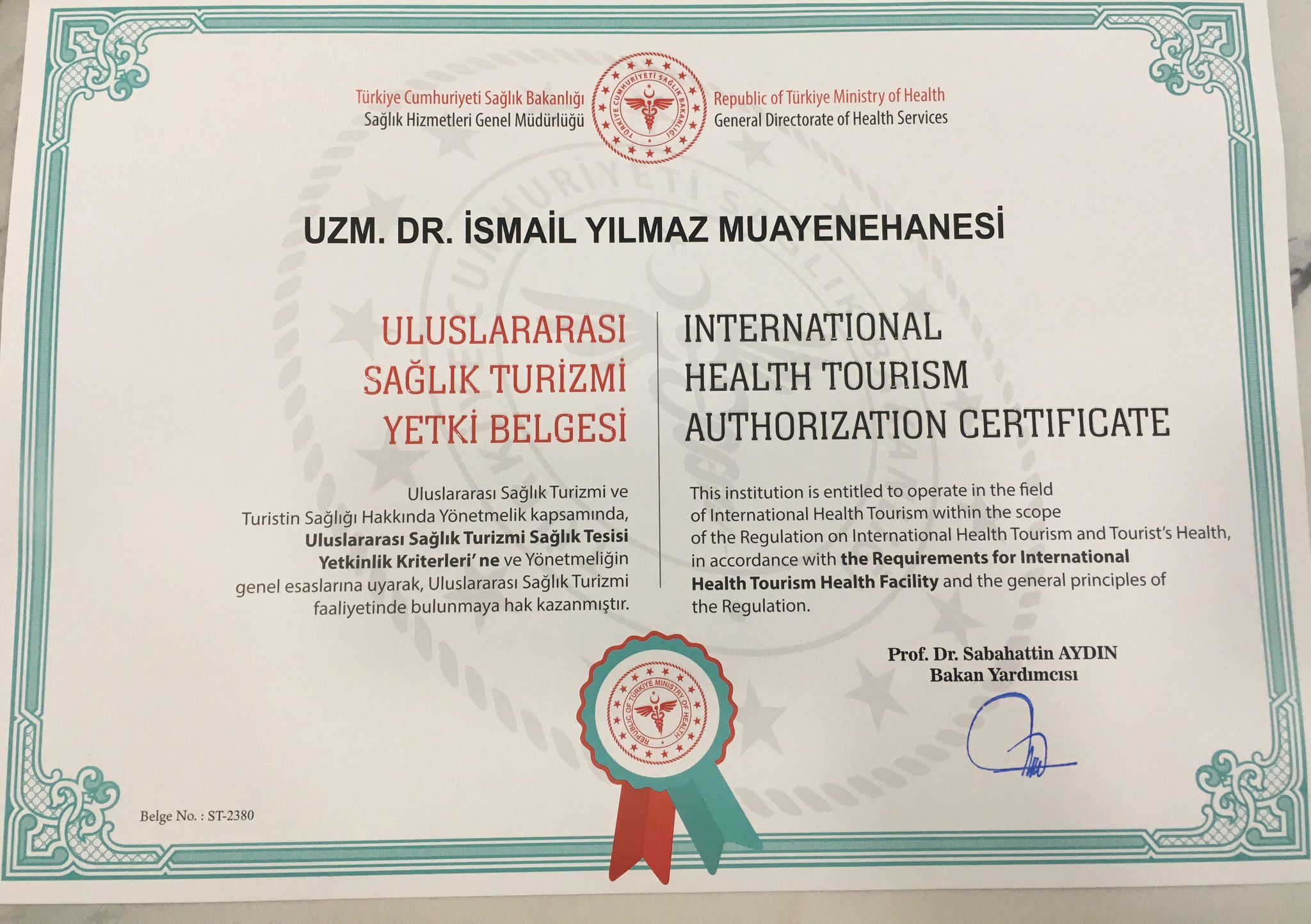
İSOM Orthopedics is in Levent, Beşiktaş, on the European side of Istanbul. It was founded in 2000 by Dr. İsmail Yılmaz and has about 25 years of clinical experience, with orthopedics and traumatology and physiotherapy departments in the same center. For a ligament injury, where surgery and rehabilitation depend on each other, this makes planning easier.
Practical guidance if you plan to travel for an ACL assessment or surgery:
- Before you travel: contact İSOM by phone at +90 (212) 324 0 324 or WhatsApp at +90 (533) 479 63 38. Send your MRI report and images, previous operation notes, a summary of your sport and symptoms, and your current medicines.
- Consultation: the surgeon examines both knees, reviews your imaging and explains whether rehabilitation, surgery or a combined plan fits you. Further tests may be requested.
- Timing: if you can, arrive after the initial swelling has settled and the knee moves reasonably, because early surgery on a stiff, swollen knee carries more risk of stiffness afterwards.
- How long to stay: plan for several days to about two weeks around the operation for wound checks and the first physiotherapy sessions. The remaining months of rehabilitation are normally done near home.
- After returning home: bring the operation report, the type of graft and fixation used, and the rehabilitation plan, so that your local surgeon and physiotherapist can continue it and check progress.
Related articles
Understanding the injury
- What happens when cruciate ligaments tear: the mechanics of the injury and what changes in the knee.
- Why do cruciate ligaments tear: the scientific explanation behind ligament injuries.
Symptoms and stages
- Cruciate ligament tear symptoms: the signs that suggest a ligament problem.
- Cruciate ligament tear symptoms and treatment options: an overview of how symptoms guide the plan.
- Cruciate ligament tear treatment: what the injury is, its symptoms and stages.
Surgery and recovery
- Is surgery necessary for a cruciate ligament tear: when to operate and how recovery proceeds.
Treatment abroad
- Cruciate ligament treatment in Istanbul: symptoms, diagnosis and treatment for visiting patients.
Related treatments
- Meniscus surgery: meniscus tears often accompany ACL injuries and are treated in the same operation.
- Sports injuries and arthroscopic surgery: arthroscopic treatment of knee and other joint injuries.
- Rehabilitation: the structured programme that decides much of the outcome.
- Physiotherapy: strength and movement work before and after treatment.
Frequently Asked Questions
Consultez Nos Spécialistes en Orthopédie
Contactez notre équipe médicale à Istanbul pour toute question concernant votre diagnostic, vos options chirurgicales et la prise de rendez-vous.